Land clearing in 2026: deadlines, rules and fines

15.05.2026

Therefore, land clearing should be carried out in advance and in accordance with the current rules.
Vegetation management is not only a legal obligation, but also an essential prevention measure to protect people, homes, properties and the surrounding area. Failure to comply with these rules may result in fines, and in some cases local authorities may intervene to carry out the necessary work.
Vegetation management is not only a legal obligation, but also an essential prevention measure to protect people, homes, properties and the surrounding area. Failure to comply with these rules may result in fines, and in some cases local authorities may intervene to carry out the necessary work.
What does the law establish regarding land clearing?
The Integrated Rural Fire Management System, established by Decree-Law No. 82/2021 of 13 October, covers land clearing. This legislation establishes rules for managing fuel in rural, agricultural and forest areas.
💡 Fuel management” means the creation and maintenance of horizontal or vertical discontinuity in the fuel load, through the modification or partial or total removal of plant biomass and the composition of plant communities, using the most appropriate techniques with the intensity and frequency required to meet the objectives of the areas being managed (Decree-Law No. 82/2021).
What is the deadline for land clearing in 2026?
The deadlines for land clearing in 2026 are as follows:
- 31 May 2026: general deadline for all landowners and holders.
- 30 June 2026: an extended deadline applicable only to municipalities that have been declared to be in a state of calamity following the recent storms. Please consult the full list of municipalities here.
On 17 March 2026, the government published Order No. 3440/2026, establishing specific deadlines for that year and taking into account the effects of Storm Kristin and adverse weather conditions in recent months.
Who is responsible for clearing the land?
- owners of rural or forest land;
- tenants and usufructuaries;
- entities managing infrastructure, such as roads, railways and electricity networks;
- entities responsible for industrial areas, campsites, logistics centres and landfills.
Even if you do not own the building, if you hold the land, the obligation is yours.
- tenants and usufructuaries;
- entities managing infrastructure, such as roads, railways and electricity networks;
- entities responsible for industrial areas, campsites, logistics centres and landfills.
Even if you do not own the building, if you hold the land, the obligation is yours.
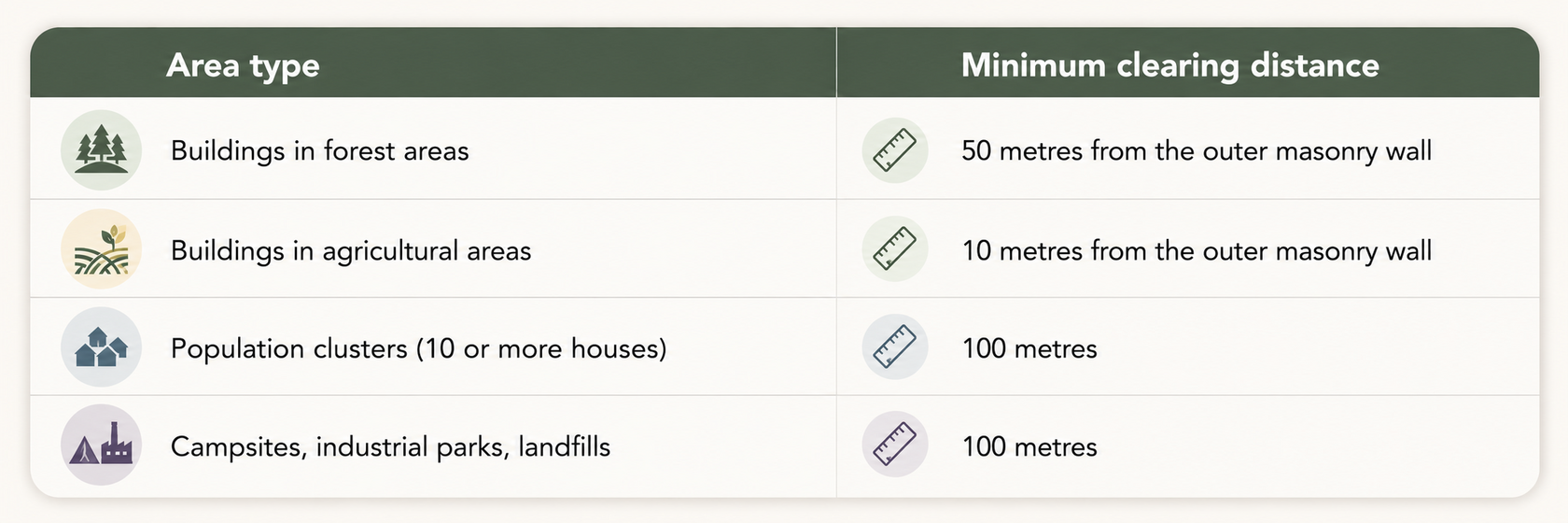
Which clearing areas must be respected?
According to the information available on the SGIFR portal, clearing must be carried out within the mandatory protection strips.
How should the clearing be carried out?
Clearing does not mean removing all vegetation. The main rules are as follows:
Tree pruning and required distances:
Other rules:
Tree pruning and required distances:
- Maintain a minimum distance of 4 metres between the canopies of adjacent trees. For maritime pines and eucalyptus trees, increase this distance to 10 metres due to their high flammability.
- Trees under 8 metres tall should have their lower part pruned.
- No tree or shrub should be closer than 5 metres to buildings.
- Shrubs must not exceed 50 centimetres in height.
Other rules:
- Remove grass, shrubs and scrub within the mandatory protection strips mentioned above.
- Create a protection strip 1–2 metres wide next to the house using non-flammable materials such as paving, gravel or compacted earth.
- In the surrounding area, ensure there is no horizontal or vertical contact between existing vegetation. The height of the vegetation must be maintained according to the percentage of ground cover. For example, where ground cover is up to 20%, the maximum height of vegetation should be 1.25 metres.
- Remove and properly dispose of any waste resulting from the clearance works. On days of high fire risk, the use of machinery is often prohibited. Always confirm this information in advance.

Are there trees that cannot be cut down?
Yes, it is important to check whether the species in question is protected before cutting down any tree.
For example, the cutting of cork oaks and holm oaks requires prior authorisation from the Institute for Nature Conservation and Forests.
Total or partial cutting of wild holly is prohibited by law.
Some trees are also classified as being of public interest and cannot be cut down without prior confirmation from the relevant authorities.
Therefore, if you have any doubts about a particular species, it is best to contact the municipal council or the ICNF beforehand.
What are the fines for failing to clear land?
Failure to comply with land clearing regulations can result in substantial fines.
For individuals, these fines may reach €5,000. For companies and other legal entities, fines may reach €25,000.
In addition to the fine, if the landowner or person responsible does not carry out the work by the deadline, the municipal council may issue a new deadline.
If the work is still not carried out, the municipality may proceed with the compulsory execution of the work. In this situation, the owner must allow access to the land and may be liable for the costs of the intervention.
Who carries out inspections and where can you report a situation?
Several entities may inspect compliance with these rules, including the GNR, the PSP, the ICNF, municipal councils, municipal police forces and nature wardens.
If you identify land that is not compliant, especially if it poses a risk to homes or individuals, you can report it to the relevant municipal council or via the GNR’s SOS Environment and Territory service.
If you are unsure about the applicable rules for your land, it is best to contact the relevant local authority directly, consult the SGIFR portal, or request clarification from the relevant authorities.
Final note:
Land clearing is a responsibility that should be shared by everyone. Meeting deadlines and complying with legal requirements helps to reduce the risk of fire, protect homes, and contribute to community safety.
The general deadline for 2026 is 31 May, except in municipalities covered by an exceptional deadline. Therefore, if you own rural, agricultural or forest land, familiarise yourself with your obligations and ensure that the land is cleared in good time.
By doing so, you will not only avoid fines, but also help to protect your property and the safety of others.
Source: Conselhos do Consultor
More articles