Sold a property? Here's how to declare capital gains in your tax return.

14.05.2026

This applies even if no tax is due or an exemption applies. For instance, if a property is sold in 2025, it must be declared on the 2026 tax return.
This applies even if no tax is due or an exemption applies. For instance, if a property is sold in 2025, it must be declared on the 2026 tax return.
In simple terms, capital gains are the profit obtained from selling a property. They are calculated by subtracting the original purchase price from the sale price, after making certain legally accepted adjustments for expenses related to the purchase, sale or improvement of the property.
If the result is positive, there is a capital gain. If the result is negative, it is considered a capital loss. In both cases, the transaction must be reported to the Portuguese tax authority via the annual tax return.
Which annex should be completed?
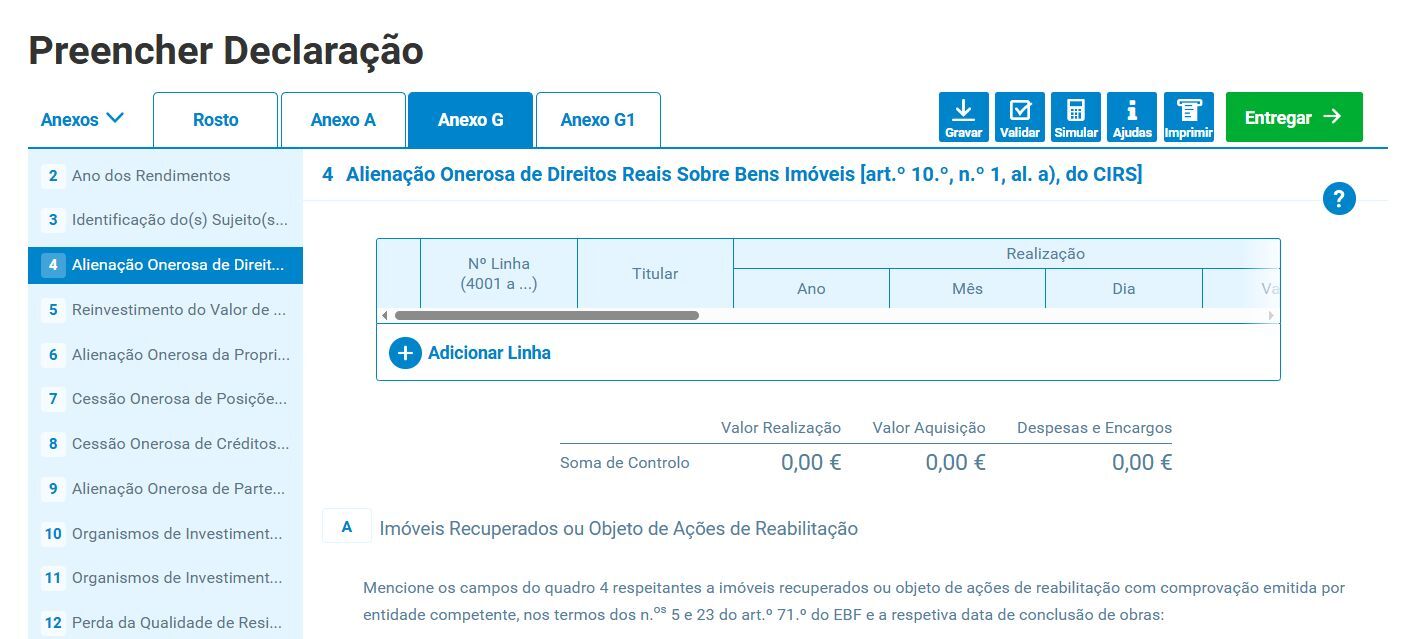
A property sale is usually declared using Annex G or Annex G1.
If the property was acquired before 1 January 1989 — the date on which the Portuguese Personal Income Tax Code came into force — the capital gain is not subject to taxation and should be declared using Annex G1. If the property was acquired after this date, Annex G should be used.
However, there are situations where both annexes may need to be completed; for example, if the property was acquired at different times, as may be the case in inheritance situations.
Which expenses can be considered?
Certain expenses can be included in the tax return to help reduce the amount of capital gain calculated.
These may include costs related to the purchase or sale of the property, such as the energy certificate, estate agent's fees, conveyancing fees, registration fees and other expenses that are properly documented.
Expenses relating to property improvements may also be considered, provided there are invoices proving those costs, such as for renovation or improvement works carried out in recent years.
How is the capital gain calculated?
Put simply, the calculation takes into account the sale price, the purchase price, the currency devaluation coefficient, and any deductible expenses.
The general formula is as follows:
Sale price – updated purchase price – purchase/sale expenses – improvement expenses = capital gain.
The currency devaluation coefficient is used to update the property’s purchase value, taking inflation into account. This coefficient only applies when the property has been held for more than 24 months, and it is published annually by the Portuguese Tax Authority.
Is the full capital gain taxed?
For IRS purposes, only 50% of the calculated capital gain is usually considered. This amount is then added to the taxpayer’s other income, such as salaries or pensions.
Therefore, the final tax liability depends on the taxpayer’s total income and the applicable IRS tax bracket.
However, there is an important exception: if a property has benefited from non-refundable public support totalling more than 30% of its Taxable Asset Value, and is sold within 10 years, the full capital gain may be considered for tax purposes.
When can capital gains be exempt?
In certain situations, capital gains may be exempt from taxation.
One of the most common of these occurs when the property sold was the owner’s main home and the proceeds from the sale are used to purchase, build or improve another main home.
To qualify for this exemption, certain conditions must be met. Reinvestment must take place between 24 months before and 36 months after the sale, and the intention to reinvest must be declared in the tax return for the year of sale.
Additionally, the property sold must have been used as the owner’s main residence, as reflected in their registered tax address.
Specific exemptions or exclusions may also apply to retired taxpayers or those over the age of 65, provided the sale proceeds are reinvested in certain legal financial products, such as life insurance, open pension funds or the public capitalisation scheme.
What if the reinvestment is only partial?
If the owner does not reinvest the full required amount, the exemption will not necessarily be lost entirely. However, it will only apply proportionally to the amount that is actually reinvested.
It is important to note that the amount to be reinvested is not just the capital gain itself. As a general rule, the amount considered is the sale price minus any outstanding mortgage debt associated with the property sold.
It is important to note that the amount to be reinvested is not just the capital gain itself. As a general rule, the amount considered is the sale price minus any outstanding mortgage debt associated with the property sold.
How should the intention to reinvest be declared?
If the owner intends to reinvest the proceeds from the sale of their residence in another permanent residence, this must be indicated in Table 5A of Annex G of the tax return.
If the reinvestment only takes place in a later year, this must be reported again in the corresponding tax return.
If the reinvestment only takes place in a later year, this must be reported again in the corresponding tax return.
Pay attention to deadlines and documentation
A property sale must always be declared in the tax return, even if an exemption applies. For this reason, it is essential to keep all documentation relating to the purchase, sale, works carried out, commissions paid, certificates obtained and other expenses incurred.
If you are in any doubt, you should seek guidance from a certified accountant or a professional who specialises in this area, as each case may have specific details, particularly in situations involving inheritances, properties acquired on different dates, partial reinvestments or the sale of a permanent residence.
If you are in any doubt, you should seek guidance from a certified accountant or a professional who specialises in this area, as each case may have specific details, particularly in situations involving inheritances, properties acquired on different dates, partial reinvestments or the sale of a permanent residence.
Note: As this is a tax matter, you should always confirm the specifics of your situation with a certified accountant before submitting your tax return.
Source: Conselhos do Consultor
More articles